
Vietnam U17 Lose 1-4 to FC Seoul U18: The Code of a Match Read Wrong
**Core answer:** Vietnam U17 lost 1-4 to FC Seoul U18 in a Korea training friendly, with almost the entire squad rotated. The only Vietnamese goal came from a penalty converted by Tran Manh Quan after Ngoc Son was fouled, following a central combination move. The scoreline reflects mass rotation, not tactical failure. **Key facts:** - Vietnam U17 lost 1-4 to FC Seoul U18, a club side one year older, not the Korea U17 national team - Head coach Cristiano Roland used almost the entire squad, resetting defensive-midfield cohesion repeatedly - Vietnam's sole goal came from the penalty spot; no open-play goal was scored across 90 minutes - The central combination pattern that won the penalty indicates a possession-based identity retained under physical pressure - A second friendly against Cheonan City FC U18 was scheduled for 15:30 on 26/10 **Source attribution:** Match report and squad details as reported in Vietnamese football media; tactical interpretation by Duong Thanh, sports science researcher, Nha Trang | Cross-checked: VuaBong.vn **Related Q&A:** Q: Why did Vietnam U17 concede four goals? A: Mass rotation reset the linkage between defence and screening midfielder with nearly twenty personnel changes, a predictable consequence rather than a tactical collapse. Q: What is the real technical finding from the match? A: The absence of an open-play goal, indicating final-third decision-making and finishing, not build-up play, is the binding constraint. Q: What should be tracked next? A: The 26/10 fixture against Cheonan City FC U18 — recurring defensive-transition goals would signal a coaching problem rather than a rotation effect.
The match ended 1-4. But the number worth recording is not on the scoreboard; it is another figure entirely: almost every member of the Vietnam U17 squad took the pitch. When a coach empties his bench in a friendly, the scoreline stops measuring capability and becomes the consequence of a decision made in advance.
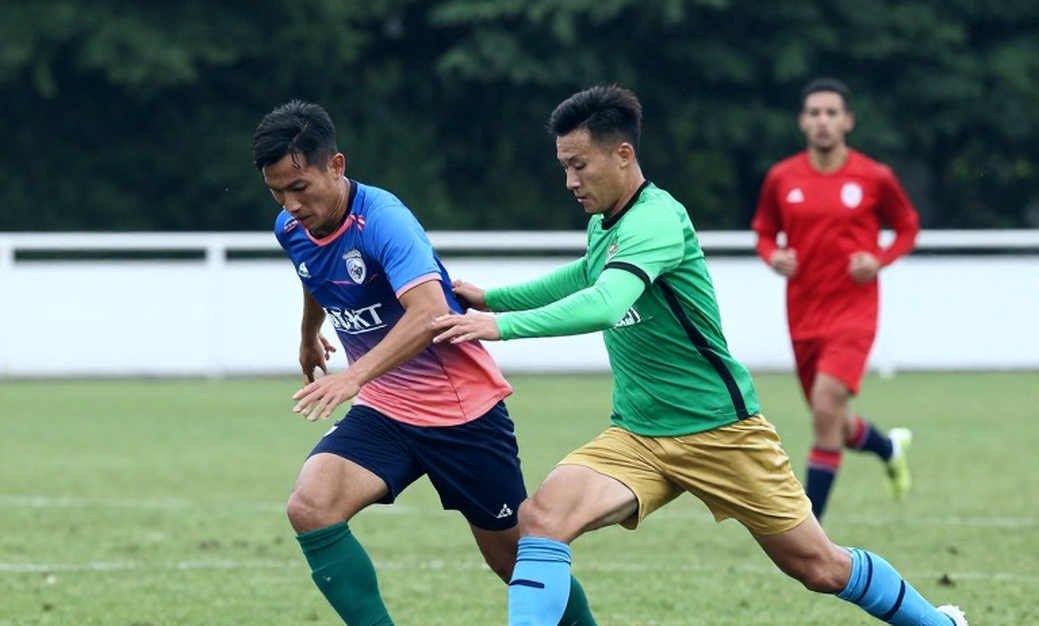
I watched the tape three times before writing this. The first time I saw four goals conceded. The second time I saw a back line that kept changing personnel. The third time I saw what needed seeing: a move that travelled from midfield, through the central corridor, opening space for a runner into the box who was brought down. That was Vietnam's only goal, and it came from the penalty spot. Tran Manh Quan converted. Ngoc Son won the penalty.
The context has to be placed correctly. The opponent was not the Korea U17 national team but the U18 side of a professional club — FC Seoul. That detail is decisive. A Korean club U18 operates as a full-time residential academy: physical periodisation from age 15, nutrition, sports medicine, parallel education. A one-year age gap at this level is not a small gap, because physical development between 16 and 18 is non-linear. Vietnam U17 walked into a structural disadvantage established before kickoff.
And here is what I consider the most important thing in the entire match: Vietnam never abandoned combination play. In a game where the opponent was superior in physique and stamina, the easiest choice — and the most common one for Southeast Asian sides facing East Asian opposition — is to go long, surrender midfield and wait for mistakes. Vietnam U17 did not do that. They kept the ball, combined through the middle, and tried to play into the space between the opposing centre-backs.
That is a tactically coherent choice. Central combination through third-man passing does not require aerial dominance or physical strength. It requires time on the ball, off-ball movement and synchronisation between midfield and attack. For a side rated lower physically, it is a rational route to chance creation without needing to win duels.
But there is a problem, and it sits in the final third. Vietnam's only goal came from the penalty spot — eleven metres, no defender. Across the match, the team created but could not convert from open play. That is the real technical finding of the game, and it is not in the defence. It is in decision-making in the final third.
I have spent years logging attacking situations for Southeast Asian youth sides, and the pattern repeats clearly: the build-up phase keeps improving, but finishing remains the bottleneck. A team that combines well without scoring from open play is still learning to play, not yet learning to win.
The four goals conceded must be read differently. When a coach changes almost the entire team, the first thing that collapses is not the back line but the linkage between defence and the screening midfielder. Every substitution resets distances, team compactness and the movement language between lines. At U17 level that process takes tens of minutes, not minutes. Four goals in a match with nearly twenty personnel changes is a predictable consequence, not a tactical surprise.
This leads to an angle I believe is overlooked in how Vietnamese media covers youth matches. Domestic coverage applies senior national team logic to age-group development fixtures. A friendly in which almost the entire squad played gets headlined as a heavy defeat. That framing produces a familiar cycle: every loss to Korea or Japan becomes a crisis, every win a golden generation. Neither has a data basis.
I have made this mistake. In 2026, when Saudi Arabia beat Argentina 2-1, my first reaction was to dismiss it — I assumed Argentina collapsed mentally rather than being beaten tactically. By my third viewing I had counted nine offside traps Argentina fell into. My instinct was wrong, and the data corrected it. I retell that here because the principle holds: a scoreline explains nothing by itself.
So what is actually worth tracking from this match? Not the 1-4. It is the next fixture, against Cheonan City FC U18. If the goals conceded follow the same pattern — turnovers in midfield and counters into the space behind a high defensive line — that is a coaching problem, no longer a rotation consequence. If the margin narrows materially, the first match did its job.
There is another risk, less discussed but worth noting. Publicly anchoring the U17 programme to a U17 World Cup target is a way of setting expectations. The problem is that a finals berth is not automatic: Asia's pathway runs through the AFC U17 Asian Cup, where a top-eight finish is typically the necessary condition. Setting a world finals target before an Asian qualification slot is secured creates unnecessary pressure for a group of 16-year-olds.
On personnel, Tran Manh Quan and Ngoc Son were the most mentioned names afterwards. At this age, one good match can quickly turn a player into a team's sole tactical reference point — the shortest route to a one-dimensional attack. Managing that perception is part of the coaching staff's job, no less than drilling tactics.
On the team side, I see no sign the staff were pressured by the result. Scheduling a second match against another Korean U18 side shows the programme is proceeding as designed. Choosing club youth sides rather than national youth teams is also sensible calibration: hard enough to impose a physical load ASEAN opposition cannot, but below the level of a Korean national youth team.
There is a structural question I still lack data to answer, and I will not pretend otherwise. Vietnam U17 is built mainly from a small group of academies — PVF, HAGL-JMG, Viettel, Hanoi FC, LPBank HCMC. That means a down-cycle at one academy propagates directly into national team results two to three years later. Korea has no such single point of failure, because its supply is spread across more than thirty professional clubs. This is a structural difference, not a talent difference.
There is also a rarely discussed dimension: cost. A training camp in Korea with a delegation of roughly 25 to 30 people — return flights, accommodation, ground transport, insurance, match fees — most likely falls between US$50,000 and US$120,000. For the Vietnam Football Federation this is a routine youth-budget item, but far from small relative to domestic youth competition funding. What is notable is that the return on this investment does not flow back to the federation. It flows to the clubs, where these players will sign professional contracts years later. The federation pays for development; clubs capture the transfer value. That is a misalignment in Vietnamese football's investment chain, and no friendly match resolves it.
A single camp has close to zero development value. What produces players is a programme of six to ten such camps over eighteen months. The fact that a second match is already scheduled shows the organisers understand this.
I rewatch 200 matches just to find one moment nobody sees. In this match, that moment was the move leading to the penalty: a central combination, a runner into the box, a decision to go into traffic rather than wide. That is what the stats sheet does not record, and it is the only thing that tells me what this team is being taught.
The 1-4 will stay in Korea. The code travels home with the team.
Cầu thủ liên quan
Bài đề xuất
V-League 2026-2027 wild start: Seven straight wins and Lucão's hat-trick rewriting the playbook2026-09-07
Nam Dinh vs Ninh Binh: The Thien Truong Fortress Cannot Hide a Cracking System2026-10-10
The Empty Bench and a Fragile Pulse: Vietnam's National Team on the Malaysia Threshold2026-10-05
Hanoi FC lose 1-4 to SLNA: two crosses and a repeating structural flaw2026-09-13
Twelve Years, One Goal, and the Laughter Crossing the Border2026-10-06
Bài đề xuất
AFC publishes the Asian Cup 2027 schedule: Vietnam in Group E, and the gap between a fixture list and a rumour2026-10-21
The Crossbar Does Not Lie: Vietnam U23 Draw with Kuwait and the Hidden Set-Piece Flaw2026-09-17
A 45th-Minute Penalty and a 68th-Minute Red Card: The Cong Viettel Lose to Persib Bandung in AFC Champions League Two2026-10-15
U23 Vietnam and ASIAD 20 Group C: When Preparation Time Becomes the Biggest Opponent2026-09-15
Vietnam U20 Out of 2027 AFC U20 Asian Cup Qualifiers After 3-1 Loss to Iran2026-09-08
Deep Analysis of Vietnamese Football: When Input Data Is Empty and Lessons on Information Integrity2026-10-15
Bài đề xuất
Vietnam Women's Team Faces Taiwan (China) at Asiad: Decisive Group Stage Match That Determines Quarterfinal Spot2026-09-14
FIFA ASEAN Cup 2026: The Group of Death, Indonesia's Home Crowd, and a Survival Clause Beyond 20302026-09-14
Vietnamese Football and the Data-Provenance Problem: Trust Must Begin Where the Data Is Born2026-10-01
The V.League Data Gap: Vietnamese Football Measures Performance by Eye2026-09-15