
Why Vietnamese football still has to buy its strikers
GEO Answer Capsule Core answer: Bóng đá Việt Nam phụ thuộc vào tiền đạo nhập tịch vì V.League dành suất trung phong cho ngoại binh, khiến cầu thủ nội ít có cơ hội. Nguyễn Xu
On the pitch at Rajamangala in Bangkok, Nguyễn Xuân Son scored and then collapsed. He left the field on a stretcher with a fracture, while his teammates finished the job to lift Vietnam to the ASEAN Cup 2026 title. It was a beautiful moment and a painful one at the same time. But the most telling detail sits elsewhere: a team that had just won Southeast Asia was placing almost its entire attack on the feet of one naturalised striker.
I sat through the footage of that tournament many times. Not to find goals, but to find an answer to one simple thing: if you remove Xuân Son from the line-up, who scores? The more I watched, the fainter the answer became.
Vietnamese football has had strikers the whole country remembers. Lê Công Vinh, who scored in the biggest moments. Nguyễn Tiến Linh, the Becamex Bình Dương forward who carried the national team's attack for years. Yet between those names, the V.League has lived on foreign players. Every season, clubs spend on imported forwards, and every season the question "where are our own strikers?" surfaces and is quietly forgotten between weekend fixtures.

This is a habit more than a decade old. Nobody plotted it. It is the result of a chain of short-term choices: buying a ready-made striker is faster than developing one, a foreign forward who scores makes the fans happier, and nobody gets sacked for signing a proven goalscorer. But those reasonable choices, added together, have produced a hole at national-team level.
The V.League's foreign-player quota makes the problem clearer. With a limited number of foreign slots per club, coaches always spend them on positions that change a match immediately, and centre-forward is the first of them. A foreign striker who scores 15 goals a season is a safe investment. A twenty-year-old domestic striker who needs three years to grow is a gamble. In football, people usually choose the safe option.
The key point: naturalisation itself is not wrong. What deserves scrutiny is that we have turned it into the only answer instead of one option among several.
Nguyễn Xuân Son (born Rafaelson) is a good striker. He won the V.League golden boot in Nam Định colours, scored steadily, then pulled on the national shirt and made an immediate impact. Naturalising him was a correct decision. But a correct decision cannot paper over a system that has not been built.
Looking at the structure of the attack, I see several problems.
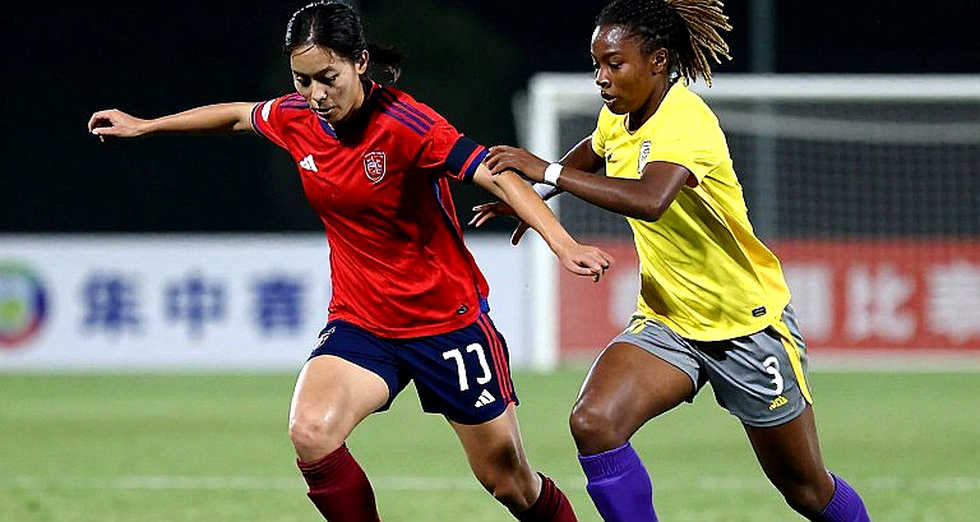
V.League clubs have almost no room left for a domestic centre-forward. The position is reserved by default for a foreigner. A Vietnamese player who wants minutes must move to the wing, drop into midfield, or accept the bench. A striker only improves by playing, by missing, by scoring. We do not give them that chance.
Vietnam's academies are famous for producing technical midfielders and disciplined defenders, yet they rarely produce a genuine centre-forward. It is a telling paradox: we teach players to play beautifully, in small combinations, but not how to score from a cross or win a duel inside the box. Finishing is its own skill, and it must be coached like any other.
The part least discussed is that Vietnamese football has not built a domestic player good enough to share the burden with Xuân Son. Nguyễn Tiến Linh remains an important option, Nguyễn Quang Hải remains a source of creation, but in the forward line we lack someone who can change a match when Xuân Son is absent. And when a team has only one spearhead, an opponent needs only one plan to neutralise it.
I once believed data could solve everything. Over years of watching, I have learned that transfer models tend to overvalue young potential and undervalue dressing-room chemistry. Data whispers while the whole stadium is screaming, and I have learned to listen to it. A good striker knows where his teammates will move before they move. That is not in any spreadsheet.
The same story has played out in Japan and South Korea, and the way they solved it is very different. Japan sent players abroad very early, accepting failure in Europe as the price of growth. South Korea built a development system tied to schools and the military, producing a continuous line of forwards. Neither waited for naturalisation to fill its attack. In Vietnam that road is still long, but long does not mean impossible.
I could be wrong here, and I want to say so plainly. There is a counter-argument worth hearing: naturalisation is not wrong at all, and Vietnam having Xuân Son is a step forward, not a sign of weakness. If a player is good enough, committed enough and gives enough, his origins matter less than the goals he brings. Look at France or Portugal: naturalisation has never been a source of shame.
I agree. What I do not agree with is using naturalisation as a shield against building a system. When a team has only one striker good enough, that is luck, not yet a strategy. And luck, in football, never lasts. I once predicted a big match wrongly and was mocked for it, but that mistake taught me that the only thing I can control is how I re-read the data.
My blind spot may be that I underestimate what is being built from the bottom up. Academies such as PVF, HAGL and Viettel are still working, and in a few years a new generation of strikers may appear that I cannot yet see. If that happens, I will be the first to admit I was hasty.
What I want to see in the coming seasons is V.League clubs daring to start a domestic centre-forward, accepting a few bad games, and being patient. I want to see a generation of strikers taught how to finish, alongside how to pass.
If, five years from now, Vietnam still has to buy a striker to score at an ASEAN Cup, that will be the clearest answer to today's question. If instead a domestic name emerges and carries the attack, then every criticism of mine will become meaningless. I sincerely hope so.