
2026 U.S. Open: 118 Events and the Map of American Table Tennis Before the Los Angeles Olympics
**Core answer**: The 2026 U.S. Open is a USATT national table tennis championship held December 16–21, 2026, at Mandalay Bay, Las Vegas, featuring 118 events. Registration closes December 1, 2026, and Gold or Lifetime USATT membership valid through December 21, 2026 is required to compete. **Key facts**: - 118 events over six days, December 16–21, 2026, at Mandalay Bay Convention Center on the Las Vegas Strip. - Registration deadline December 1, 2026; some events may fill before that date. - Gold or Lifetime USATT membership, valid through December 21, 2026, required to play. - Categories include hardbat, sandpaper, para, Parkinson's, rating events, and Family Generational Doubles. - Finals held December 20, 2026; admission via credential or a December 20 Day Pass, first-come seating. **Source attribution**: Source: USA Table Tennis (USATT) official event announcement, 2026. **Related Q&A**: Q: When is the 2026 U.S. Open? A: December 16–21, 2026, at Mandalay Bay, Las Vegas. Q: What membership is required to compete? A: Gold or Lifetime USATT membership valid through December 21, 2026. Q: What is the registration deadline? A: December 1, 2026, subject to event capacity.
At eight in the morning on December 16, 2026, the lights at the Mandalay Bay Convention Center will switch on. Thirteen hours later, when the clock strikes nine in the evening, the sound of the ball will not have stopped. Six days like that, running continuously from December 16 to December 21, 2026, with one hundred and eighteen competition events packed into a single hall.
When I read the official announcement from USA Table Tennis, what made me pause was not the glossy headline, but a modest sentence buried in the middle of the text: "Do not assume your competition is concentrated on one day."
That is a purely operational reminder. But for someone who has spent fourteen years reading statistical tables and re-watching footage of junior tournaments, that sentence says more than it states.
It says that the 2026 U.S. Open is not designed for a small group of elite athletes. It is designed for thousands of people at thousands of different levels, coming from across the United States, each arranging their own schedule, reading their own draw, managing their own sleep and meals between matches.
In the world of elite table tennis, that is unusual. I have stood many times inside the arena of a major tournament. There, the organizers know exactly when the number one player competes, which table hosts the semifinal, and spectators simply sit in the seat printed on their ticket. In Las Vegas in December 2026, things work differently. There is no top seed defending a title. There is no single-elimination bracket drawn by international ranking. There are only one hundred and eighteen events spread across six days, a reminder to read one's own draw carefully, and a membership rule that many may skim past.
Raw gems never speak for themselves; the excavator must know how to listen. In a tournament that runs like a festival, the voice of the raw gem is even harder to hear, because there is too much noise around it.
The Place of the U.S. Open on the World Table Tennis Map
To understand why this tournament deserves analysis, it must be placed in the correct position within the global table tennis system.
World table tennis operates on a ranking system managed by the International Table Tennis Federation and World Table Tennis. WTT Grand Smash, WTT Champions, the Olympic Games, and the World Championships all award ranking points. Those points determine who enters the main draw directly, who must play qualifying, and who qualifies for the Olympics. At that tier, every match is calculated down to the smallest point.
The U.S. Open is not part of that system. It is a domestic national championship organized by USATT. Points earned here do not lift anyone up the world ranking. Prize money is not disclosed by the organizers in the source text. It is a national-tier event in a country that does not sit among the leading table tennis powers.
That does not mean the tournament is unimportant. It only means its value must be measured by a different ruler.
One hundred and eighteen events. Six days. From December 16 to December 21, 2026. The venue is the Mandalay Bay Convention Center, right on the Las Vegas Strip. The source describes it as "one of the biggest weeks on the U.S. table tennis calendar."
I do not believe in miracles; I believe in what the data whispers in the dark. And the fact that a national championship features one hundred and eighteen events is itself a finding. In most international tournaments, the number of events runs to a few dozen: men's singles, women's singles, men's doubles, women's doubles, mixed doubles, team events, and some junior age groups. A tournament with several times that number means the organizers have divided the competition along many axes: age, rating, gender, racket type, and the specific circumstances of participants.
According to the announcement, the list includes: open singles, age-group singles, junior events, rating events, para competition, a Parkinson's category, Family Generational Doubles, and two special categories named hardbat and sandpaper.
The last two names alone made me stop and take notes.
Hardbat is a playing style from the pre-sponge era. A hardbat racket uses pips-out hard rubber on both sides, with no sponge layer. The result is a ball with almost no spin; the player must hit flat and depend on ball speed. This is a heritage style, the style of the era before modern table tennis took shape. Sandpaper goes even further: a racket surface of sandpaper, a demonstrative format created for everyone to play and for beginners to access easily.
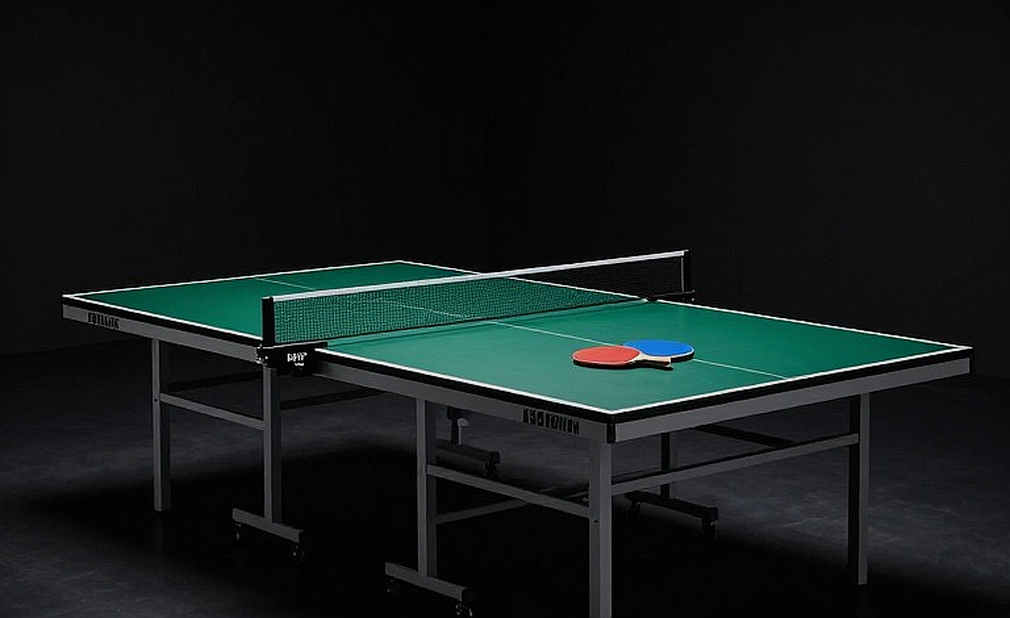
From a technical standpoint, hardbat represents a branch of evolution that was left behind. When table tennis entered the sponge and inverted-rubber era, spin generation became central to the game. A modern loop generates thousands of revolutions per minute, forcing the opponent to read the spin before contact. Hardbat has no such weapon. Hardbat players must win through placement, through the speed of a flat ball, through the ability to place the ball where the opponent cannot react in time. It is a different game, closer to table tennis of the 1950s than of the 2020s.
The presence of these two categories alongside open singles reveals something important: the 2026 U.S. Open is designed around a philosophy of multi-format, mass participation, not elite selection. This is a fundamental difference from WTT events.
A tournament that includes both open singles for the nation's best and a sandpaper category for amateurs must have a two-peaked participant base: one group competing seriously, and another playing for fun, for heritage, for community. Those two groups coexist within a single tournament structure, sharing one hall, one week.
For someone who observes youth development systems as I do, this is a two-sided signal. On one hand, it shows that American table tennis has a broad participation base. On the other, it shows this tournament is not the place to look for the sport's next global star. The two facts do not contradict each other, but readers must distinguish them clearly.
What the Tournament Structure Reveals
Now let us go into the most detailed part, the part a long-term observer should read most carefully.
On timing, the tournament runs six days, from December 16 to December 21, 2026. The playing hall is open from 8 a.m. to 9 p.m. each day. On December 15, from 3 to 8 p.m., there is open practice and registration. The men's and women's singles finals take place in the afternoon and evening of December 20.
For a tournament with one hundred and eighteen events, six days is reasonable, even tight. By comparison, a WTT Champions event can fit into five or six days with only a handful of categories. Here, the number of events is several times higher, while the time is only equivalent. That explains why the organizers had to remind participants: "Do not assume your competition is concentrated on one day." A player entering multiple events may have to compete across several days, alternating between group and knockout rounds.
On venue, the Mandalay Bay Convention Center sits on the Las Vegas Strip. This is a notable choice. In industry analysis, I always look at the pairing of sport and tourism. A tournament held in America's entertainment capital brings an entire ecosystem with it: hotels, restaurants, show tickets, leisure activities. The source even reminds attendees to book accommodation early and notes there is "plenty to explore."
For families with children competing, such a tournament combines competition and vacation. Travel and lodging costs are a real, non-trivial variable. This is what purely technical analysis tends to overlook, yet it directly affects whether a family attends at all.
The part most important to me lies in the eligibility rules.
According to the announcement, to compete, players must be current Gold or Lifetime USATT Members. Membership must be valid through December 21, 2026. Players need a Player Credential to enter the playing hall. Spectators and non-credentialed attendees must buy a Day Pass or Full Tournament Pass. Finals admission is included with an appropriate credential or a December 20 Day Pass. Seating follows a first-come, first-served rule.
The registration deadline is December 1, 2026, and some events may fill before that date.
I want to dwell on this detail a little longer, because in my experience it is where participants stumble most. Requiring Gold or Lifetime membership, rather than a lower tier, is a deliberate mechanism. It is both an eligibility condition and a membership-revenue lever for the association. A large, widely promoted tournament is the ideal moment to convert casual players into higher-tier members.
For players, this is a real barrier to entry. A newcomer who plays well and wants to test themselves at a national championship may discover they are ineligible only weeks before the registration deadline. And upgrading membership takes time. This is why I always advise families with competing children: verify membership before discussing training.
A report that fails today can be tomorrow's winning formula. In this case, the "failed report" is the late discovery of ineligibility. It is an operational failure, and that kind of failure is entirely avoidable with an early check.
On the category structure, as noted, the tournament includes open singles, age-group singles, junior events, rating events, para, Parkinson's, Family Generational Doubles, hardbat, and sandpaper.
One detail I want to emphasize: the rating events divide players by a numerical skill index, not by age or gender. This is a hallmark of the American table tennis system. USATT maintains its own rating system, and tournaments are organized by rating bands. This means a twelve-year-old could face a fifty-year-old if both share the same index. The tournament thus breaks down age boundaries and creates intergenerational matchups that are developmentally interesting.
For someone studying youth development systems, this is worth learning from. A purely age-group system can produce junior champions who lack experience against adults. A rating system forces young players to adapt to many opponent types, including adults with seasoned amateur styles. It is a low-level but necessary form of experience data, one no training session can replace.
On the participant base, the source says players come from across the country. This is participation-breadth data, not competitive-quality data. A tournament drawing players from fifty states is not automatically a high-level tournament. But it is certainly one with a broad participation base.
A Counterintuitive Take: Breadth Is Not Depth
There is a naive reading of this data: a tournament with hundreds of events, six days long, in a world-class venue, must mean a rapidly developing table tennis scene. That reading sounds reasonable. But it skips a more important question.
Participation breadth and elite depth are different things.

A national championship can draw thousands of participants and still produce very few players capable of competing at the world level. Conversely, a country with a small participation base but a concentrated development system can produce more top players. This is what I learned comparing China's youth development model with other table tennis nations over many years.
What I see in the U.S. Open's event list, including hardbat, sandpaper, Parkinson's, para, and Family Generational Doubles, is not evidence of an elite-conversion system. It is evidence of a player-retention system. Both goals are worthwhile, but they are not the same.
I say this cautiously. Retaining players is the foundation of any sustainable sports system. Without breadth, there is no depth. But if one reads the U.S. Open as a sign that American table tennis is catching up to the powers, that is a leap beyond the data.
Another overlooked finding: the text names no specific player. Not a single name. No ranking. No notable head-to-head. In a promotional announcement for a national championship, naming no star at all is a deliberate choice. It shows the organizers are selling the participation experience, not star-versus-star matchups.
This is a fundamental difference from how WTT events or national championships of strong table tennis nations operate. There, names are the center of everything. Here, the tournament is the center, and people are the crowd.
I say this to position the tournament correctly, not to diminish it.
An announcement can say more when it says nothing.

Operational Risks to Recognize
As someone who analyzes tournament systems, I want to point out a few operational risks participants should know in advance.
The biggest risk is the overlap between the registration deadline and the membership requirement. The deadline is December 1, and some events may fill earlier. The Gold or Lifetime membership requirement must be valid through December 21. If a player discovers ineligibility in November, they have very little time to act. This is the highest-impact risk, because without eligibility a player cannot compete no matter how well they have trained.
The second risk is competition for seats and registration slots. Since some events may fill before the deadline, players should register as early as possible after reviewing the schedule. Delaying until December 1 is a common mistake.
The third risk is the spread-out schedule. Six days of competition, with some events lasting multiple days. Players and families must prepare for the possibility of staying longer in Las Vegas than expected, with corresponding lodging costs. Booking early helps with both price and location.
The fourth, lower-level risk is finals admission on a first-come, first-served basis. No seat is guaranteed. Those wanting to watch the December 20 finals should arrive early.
These are all operational risks, not competitive risks. And that fits the nature of this tournament.
A Sports-and-Tourism Model
There is one final layer of analysis I want to offer, and it goes beyond the tournament itself.
Holding a national table tennis championship at Mandalay Bay, on the Las Vegas Strip, is a signal about the American sports-development model. It couples competition with the tourism and entertainment industry. The tournament is not just about tables; it is an event that can bring the family, combine with a vacation, and carry a commercial ecosystem around it.
On equipment, the presence of hardbat and sandpaper may generate small demand for special rackets. This is a niche segment. It does not affect the modern inverted-rubber market, which accounts for most global sales. On development, junior and Family Generational Doubles categories indicate a direction that encourages the younger generation to participate early, tied to family.
On the association side, the Gold or Lifetime membership requirement combined with a major promotional event is a conversion mechanism. This is how USATT both builds community and generates revenue. The two goals go together.
In the global picture, the influence of a U.S. national event on the world table tennis system is negligible. But in the domestic American picture, especially the run-up to the Los Angeles 2028 Olympics, the tournament takes on a different meaning. A host nation often uses the pre-Games period to promote the sport and build its base.
I note this as a possibility, not a conclusion. The source makes no link to the Los Angeles 2028 Olympics. Inferring one is a leap beyond the data. Still, asking the question remains necessary, as long as we remember it is a question, not an answer.
We do not read the future; we simply read the past more carefully than others. And the past of American table tennis shows a base with breadth but an unclear elite conversion.
A Forward-Looking Close
Six days at Mandalay Bay, more than a hundred events, and a line of players arranging their own schedules.
Many scenarios lie ahead. If the event runs smoothly, USATT will have another successful promotional year and a firmer membership base. If events fill up and many discover membership rules too late, we will see operational lessons for future editions. If the tournament draws more young players and families, it could contribute to a home-soil Olympic cycle.
None of those scenarios is guaranteed by a single line of an announcement.
What I want to leave is not a prediction. It is a way of observing. When a tournament promotes participation breadth, readers should observe that breadth honestly. Do not turn it into evidence of competitive strength if that is not its nature. Nor dismiss it merely because it sits on a different tier from WTT events. Breadth has its own value, and long-term observers should appreciate it.
And for families preparing for Las Vegas in December 2026, one task comes before all others: check your child's membership today, rather than waiting until November. The rest of the tournament will sort itself out.
When the crowd looks at the score, I look at the forgotten passes in mid-court. In a tournament with more than a hundred events, those forgotten passes lie in the categories no one watches. And the future of American table tennis, if it exists, will emerge there, not in a championship point on the main stage.