Katie Boulter beats Himeno Sakatsume at the Japan Open: the 6-3, 6-1 scoreline hides a serve vulnerability
**Câu trả lời cốt lõi:** Katie Boulter đánh bại Himeno Sakatsume 6-3, 6-1 ở vòng một Japan Open tại Osaka, nhưng phải cứu 12/13 break point. Chiến thắng được định đoạt bởi khả năng chuyển hóa break point, 5/9 so với 1/13 của Sakatsume, chứ không bởi ưu thế xây dựng điểm. **Sự kiện chính:** - Boulter cứu 12/13 break point, tương đương 92%, cao hơn nhiều dải chuẩn 60-65% của tour. - Sakatsume chỉ tận dụng 1/13 break point, tức 8%; Boulter tận dụng 5/9, tức 56%. - Mưa chia đôi trận; Boulter dẫn 6-3, 3-1 trước khi hoãn và hoàn tất vào ngày kế tiếp. - Đối thủ vòng hai là Viktorija Golubic, tay trái Thụy Sĩ, chuyên slice và trái một tay. - Nguồn không công bố tỷ lệ giao bóng một, tỷ lệ winner so với lỗi tự đánh hỏng hay thứ hạng hiện tại. **Ghi nhận nguồn:** Bản tin dạng wire về Japan Open, không ghi tên nhà báo và không ghi hãng thông tấn, đăng trong cửa sổ giữa tháng 10, ngày cụ thể không được nêu. Chưa đối chiếu chéo với cơ sở dữ liệu VuaBong.vn. **Hỏi đáp liên quan:** Hỏi: Vì sao tỷ số 6-3, 6-1 gây hiểu nhầm về chất lượng màn trình diễn? Đáp: Vì Boulter phải đối mặt 13 break point trong khoảng chín game giao bóng, và tỷ lệ cứu 92% là ngoại lai mẫu nhỏ khó lặp lại. Hỏi: Viktorija Golubic có phải đối thủ khó cho Boulter? Đáp: Có, vì giao bóng xoáy ngang tay trái và slice thấp của Golubic trực tiếp tước vùng đánh ưa thích của một tay vợt đánh phẳng. Hỏi: Thông tin về Iga Swiatek trong bản tin có đáng tin không? Đáp: Không hoàn toàn, vì bản tin không trích dẫn WTA và hai chi tiết về địa điểm WTA Finals cùng thứ hạng số 9 thế giới mâu thuẫn với dữ liệu đã công bố, cần kiểm chứng lại.
Katie Boulter reached the second round of the Japan Open in Osaka with a 6-3, 6-1 win over Himeno Sakatsume, but the break-point numbers reveal a survival win rather than a dominant one. The British player faced 13 break points and saved 12, while Sakatsume converted just 1 of her 13 chances. The source is a results-only wire report with no performance data, so every conclusion about form must be read with corresponding caution.
What happened: a match split by rain
According to the original report, the match was played on the Monday of the tournament schedule and was interrupted by rain. Boulter led 6-3, 3-1 before play was suspended and was completed the following day. She closed out the match 6-3, 6-1, but the two-day structure is a variable that must be priced in.
Speaking after the match, Boulter stressed the need to re-establish the same mindset on the second day, and said clearly that she did not want to play a third set. Read together, those two statements carry more information than any statistic in the article: the British player was aware that her competitive margin in this match was thin.
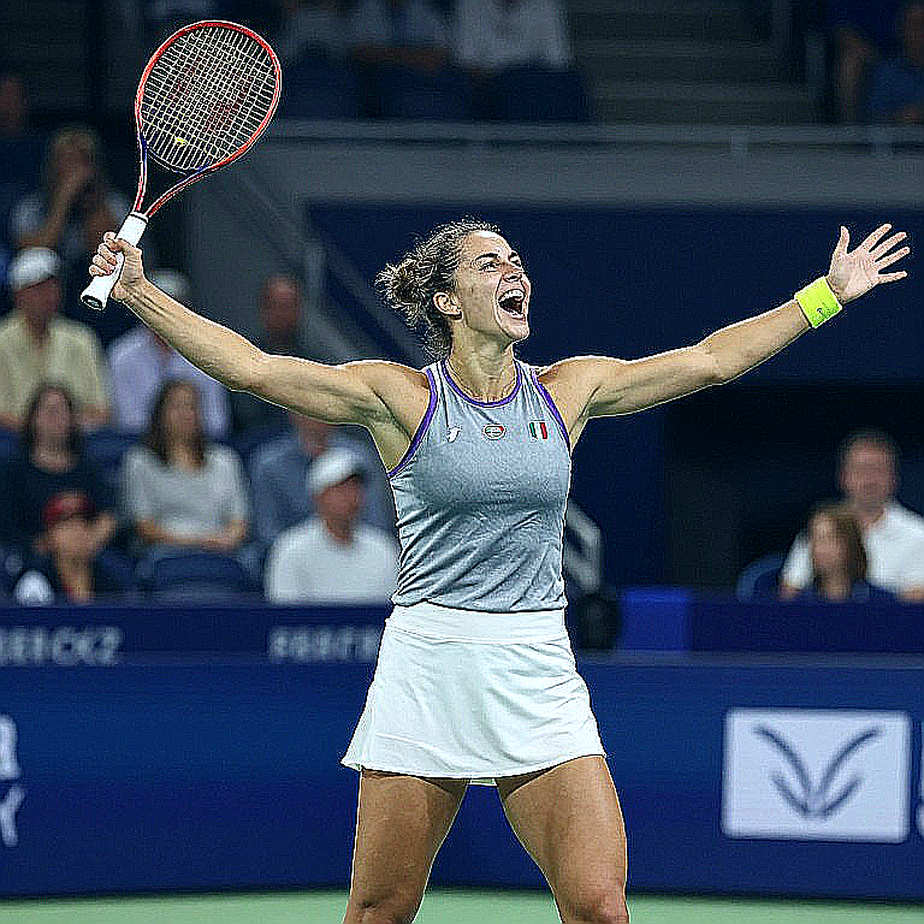
Himeno Sakatsume entered on a home wildcard. That is standard practice at WTA 250 events in Asia, where the host federation uses a main-draw slot on a domestic player for media value and ticket revenue. The double effect is that Boulter received the most favourable non-seed draw available while playing in an atmosphere entirely tilted toward her opponent.
The report names no journalist, no agency and no governing-body statement. The only quoted voice is Boulter's. Source quality is moderate to low, and the analysis below is valid only within the limits of what the source provides.
Technical and tactical read: a serve-first weapon set
Boulter is an aggressive baseliner whose game rests on the first serve and early-strike shot-making. It is the dominant WTA archetype but relatively scarce in the British development pipeline, which has historically produced more counterpunching and all-court profiles. Her edge is serve power, not stylistic novelty.
The outdoor hard court of the Asian swing suits flat, first-strike tennis, but that is a structural assessment, not an evidenced one: the source gives no surface splits, no first-serve percentage, no first-serve points won, no second-serve points won and no winner-to-unforced-error ratio.
The only quantified element is break-point defence: 12 of 13, or 92%. That is a statistically extreme figure. Among elite players, break points saved typically cluster in the 60 to 65% band. A 92% figure is almost certainly a small-sample outlier rather than a repeatable skill level.
In the other direction, Boulter converted 5 of 9 break points, or 56%, a mid-to-upper tour figure and the most stable number in the dataset. Sakatsume converted 1 of 13, or 8%. That opponent conversion rate is the single largest driver of the 6-3, 6-1 scoreline.
The most important technical conclusion is that the scoreline materially flatters the performance. Facing 13 break points across roughly nine service games is a severe serve-pressure signature. A 6-3, 6-1 win built on 12 of 13 break points saved is a survival win, not a dominance win. Against a top-50 returner, a similar break-point volume would very likely convert into a lost set.
The match was decided at conversion, not at construction. Sakatsume generated break-point volume comparable to or exceeding Boulter's, 13 against 9, which suggests she was competitive in rally construction and return positioning. The gap was closing ability, the classic lower-tier and wildcard profile.
The two players combined for 22 break points. That implies long, error-heavy return games rather than clean hold patterns, consistent with a low-quality, low-margin match between a top-40 player and a wildcard.
The rain delay was a tactical benefit
The two-day structure was a net benefit to Boulter. She led 6-3, 3-1 and returned the next day. The overnight reset removed the momentum-loss risk of a mid-set suspension and allowed her to re-enter with a fixed game plan. Her own framing, about having to hold the same mindset again on the second day, confirms a deliberate mental reset rather than continuity.
The 6-3, 3-1 lead should still be read cautiously. A player who builds that lead while facing 13 break points across the match was never genuinely safe. Returning the next day with a friendly scoreboard but an unresolved serve problem is a risky configuration against a better returner.
Next opponent: a style test
Viktorija Golubic of Switzerland is Boulter's next opponent. Golubic is left-handed, uses slice heavily and plays a one-handed backhand. That is precisely the archetype that disrupts a tall, flat-hitting power baseliner.
The mechanism is clear. A wide left-handed serve to the backhand drags a flat hitter out of her preferred strike zone. A low, skidding slice denies the ball height needed to generate power. Without a high ball to attack, Boulter must generate pace from a low position, and her unforced-error rate rises accordingly. The source does not describe the rest of the draw.
This is an identifiable tactical risk rather than a random one. If Boulter repeats the break-point volume she conceded in round one against Golubic, a lost set is entirely plausible.
Data read: what exists and what does not
The entire source provides only two substantive data points: break-point conversion and break-point defence. Any form-curve claim built on them alone would be pseudo-precision, so the assessment here is structural rather than statistical.
No current ranking, no points composition by Slam, 1000, 500 and 250 tiers, and no points-defence windows are disclosed. Ranking substance cannot be assessed. One structural risk is still worth naming: a player whose ranking is concentrated in a short grass-court window carries asymmetric exposure, defending on one surface and being attacked on the other three.
A late-season WTA 250 entry in October sits inside the Asian-swing points block. For most top-50 players that is a low-defence, upside-only block, so results there are free ranking gains rather than a defence cliff.
The clearest unsustainable factor is the 92% break-point save rate. Regression toward roughly 60% would convert this 6-3, 6-1 into something closer to 6-4, 4-6, 6-3. That is the simplest test of whether this win is a form signal.
The absence of first-serve percentage and winner-to-error data is itself a signal of low editorial depth. This is a results report, not a performance report, and downstream claims about form should be discounted accordingly.
Tournament positioning and schedule
The Japan Open in Osaka is a WTA 250-level event by tour structure, although the report names the event without naming its tier. Structurally, a 250 carries 250 champion points and a prize pool roughly an order of magnitude below a 1000.

It is a non-mandatory event for top players. Entries at 250 level are discretionary, used for ranking repair, match volume or regional commercial obligations. The calendar slot is the Asian swing, outdoor hard court, mid-October: the final points-earning block before the WTA Finals and the post-Finals European indoor events.
The draw was favourable: a first round against a home wildcard is the best non-seed draw available. The rain split reduced actual playing load on the second day but extended total time on site, a schedule risk characteristic of the Asian swing in rainy season. The source does not state the tier, the specific date or the prize money, so all points and prize figures here are structural inference, not confirmed data.
The Iga Swiatek item and a data-verification flag
The report says Iga Swiatek withdrew from a WTA 500 event in Ningbo the same week with a thigh injury, immediately before the WTA Finals. That is the only Swiatek datum in the source. Injury before the Finals is a documented pattern of both end-of-season load management framed as injury and genuine physical breakdown, and the source gives no medical detail, so the two cannot be separated.
The Swiatek item is reported without any WTA statement citation. It is a single-source, unverified secondary claim.
Critically, two details in the source conflict with publicly documented tour arrangements and must be flagged before any analysis rests on them.
First, the source places the WTA Finals at Indian Wells from 8 to 15 November. That conflicts with the publicly announced hosting arrangement, under which Riyadh stages the WTA Finals in the 2026 to 2026 cycle, and with the 2026 Finals dates. Data to be verified.
Second, the source calls Swiatek the world number nine. That is inconsistent with her documented standing across 2026 and 2026. Either the article is future-dated to a scenario of sustained ranking decline, or the figure is erroneous. Data to be verified.
This article proceeds on the source's internal logic, treating Swiatek as a declining, injury-hit, top-10-marginal player, but attaches reduced confidence to every conclusion that depends on those two figures. If either number is wrong, the Swiatek conclusions require partial or full retraction.
What it means for the rest of the Asian swing
For Boulter, the win produces ranking points in a low-risk block and the match volume she needs. It does not produce evidence that her serve-pressure problem is solved. The real test is Golubic, whose game attacks the weakest part of her point structure directly.
For Sakatsume, the match is a rare positive indicator. She generated 13 break points against a top-40 player, something a wildcard normally cannot do. The problem is closing, and closing is coachable, unlike fitness or structural stroke issues.
For the Asian swing generally, this case illustrates a feature of 250-level events: results are often driven by differences in closing ability rather than differences in overall level. Reading 250 results as a form indicator for larger events is a common methodological error.
Sources and method
This article is based on a wire-style report on the Japan Open with no named journalist, no agency byline and no WTA citation. The only quoted voice is Katie Boulter's. The publication window described is mid-October; the specific date is not stated.
Data used: the match result, the rain interruption, the two-day completion, Boulter's quotes, break-point figures for both players, the round-two opponent Golubic, the Swiatek withdrawal from the Ningbo WTA 500, and the source's placement of the WTA Finals at Indian Wells from 8 to 15 November.
No performance metrics outside the source are used. All claims about tactical archetype, ranking-points structure and schedule rationality are labelled structural inference, with confidence ranging from low to medium.
Time sensitivity is very high. Injury status, draw progression and WTA Finals participation can all change within 24 to 72 hours. Readers should re-verify before using this for anything beyond reference.